How to Write a Holiday Let Welcome Guide Guests Will Actually Read
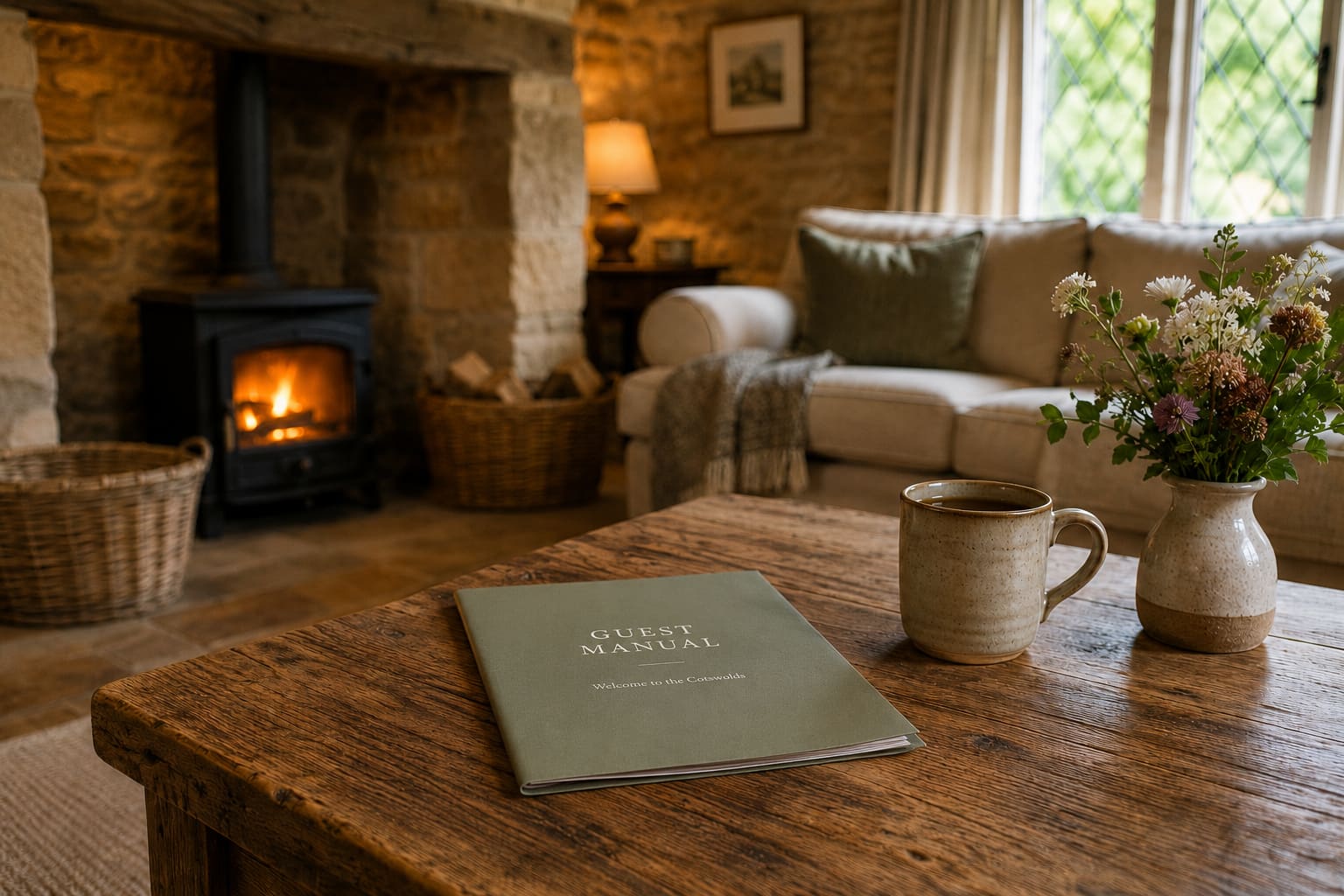
A every Cotswold holiday let has one somewhere: a laminated folder, or a Word document turned PDF, sitting on the kitchen counter with the Wi-Fi password, the bin day, and instructions for a boiler that was replaced two winters ago. Guests rarely open it. When something goes wrong, they message the host instead — often at 11pm, from the sofa, about something the folder technically covered on page four.
A welcome guide only works if guests actually use it. Here's how to write one that does.
Start with what guests ask for, not what you want to tell them
It's tempting to write a welcome guide the way you'd write a property listing — highlighting the log burner, the view, the thoughtful touches. Save that for the listing itself. A welcome guide is a reference document, and guests use it the way they use a search engine: they arrive with a specific question and want the answer in seconds.
The questions are almost always the same ones, in roughly this order:
- How do we get in, and where do we park?
- What's the Wi-Fi network and password?
- How does the heating and hot water work?
- How do the appliances work — the oven, the shower, the log burner?
- What time is checkout, and what do we need to do before we leave?
- What's good nearby — food, walks, things to do with kids or a dog?
If your guide answers those six things clearly, it will cover the overwhelming majority of questions guests would otherwise send you directly.
Write for someone who is tired and slightly stressed
Most guests read a welcome guide in the first twenty minutes after a long drive, usually while someone else in the party is asking where the kettle is. That's not the moment for charming prose. Short sentences. One instruction per line. Bold the actual numbers and passwords rather than burying them in a paragraph.
Compare:
"Our wonderful hosts have thoughtfully provided high-speed broadband throughout the cottage, and you'll find the details for connecting written on a card near the router in the hallway."
against:
Network: CotswoldCottage5G Password: bramblehedge22
The second version is the one that actually gets used.
Be specific about the things that go wrong
Every property has two or three things that reliably confuse guests — a shower that needs a firm push to switch from bath to spray, a lockbox that sticks if you don't lift the latch first, a thermostat that needs to be turned up 3 degrees above the target to actually kick in. These are exactly the details that get left out of generic templates, and exactly the details that generate a text message if they're missing.
Walk through your own property as if you were a guest who'd never seen it before, and write down every point where you'd hesitate. That list is your welcome guide's most valuable content.
Keep local recommendations honest and current
A "local guide" section is worth including, but it ages fast. A pub that closes on Mondays, a farm shop that's changed its opening hours, a walk that's been rerouted after flooding — all of it drifts out of date within a season if nobody's checking it. Either commit to reviewing it every few months, or keep it deliberately general (favourite walks, the nearest market town, the kind of thing that doesn't change) and let guests confirm specifics themselves before they set off.
Make it available where guests actually are: their phone
However well it's written, a printed folder shares the same fundamental problem: it's back at the cottage while the guest is standing in the pub car park trying to remember the Wi-Fi password to check a map. A digital guide guests can reach from their own phone — via a QR code on arrival, with nothing to download — solves that on its own, independent of how good the writing is.
That's the whole idea behind Cotswold Host: every property gets its welcome guide written up properly, in person, then delivered through a private AI assistant guests can just ask directly — "what's the Wi-Fi password", "how do we work the shower", "anywhere good to eat tonight" — instead of hunting through a document at all. If it doesn't know the answer, it tells the guest to ring you rather than guessing.
Whether or not you go digital, the underlying discipline is the same: answer the six real questions clearly, be specific about the fiddly bits, and keep it honest. That's what turns a welcome guide from a formality into something guests genuinely use — and the fastest way to stop fielding the same three questions every single changeover.
Curious what Cotswold Host would look like for your own property?
Book a free trial